

Rope access, Melbourne.
Certified rope access for façade, glazing, remedial, inspection, install and standby rescue. We reach the work other contractors can't — without the cost and delay of scaffold.
Reach the work directly — no scaffold, no delay.
360 Access is a specialist rope access contractor headquartered in Melbourne, delivering across Victoria and Queensland. Rope access lets our certified rope-access technicians get straight to the façade, the defect or the install point — so you pay for the work, not for steel standing around the building. It's faster to mobilise, lighter on the street and footpath, and far less disruptive to the people inside.
From there we self-perform the trades that usually need a separate sub-contractor: façade and glazing, remedial and sealants, cladding, painting and coatings, inspection and install — backed by standby rescue on every site.
One certified rope-access team, every scope at height.
Façade maintenance
Scheduled and reactive maintenance programs for high-rise assets.
Cladding rectification
Remove combustible cladding, install compliant non-combustible systems.
Glass & glazing
Scratch removal, defect rectification and replacement at height.
Painting & coatings
High-access painting and protective coatings without scaffold.
Remedial & repairs
Sealants, crack injection, water-ingress and balcony works.
Height safety
Install, test and certify anchors, static lines and guardrails.
Certified crews, with rescue on every site.
Every scope runs on two independent ropes, certified technicians (L1–L3), site-specific SWMS and JSAs, and a documented rescue plan. We carry standby rope-rescue capability on every job — including for builders running their own access crews.
360 Access is an IRATA International operator member (membership no. 4109/O): the company itself, not just our technicians, is audited by IRATA.
Backed by $20M public liability cover, certified rope-access technicians, AGWA membership and an integrated management system covering quality, safety and environment (ISO 9001 / 14001 / 45001 certified via ATLAS, JAS-ANZ accredited).
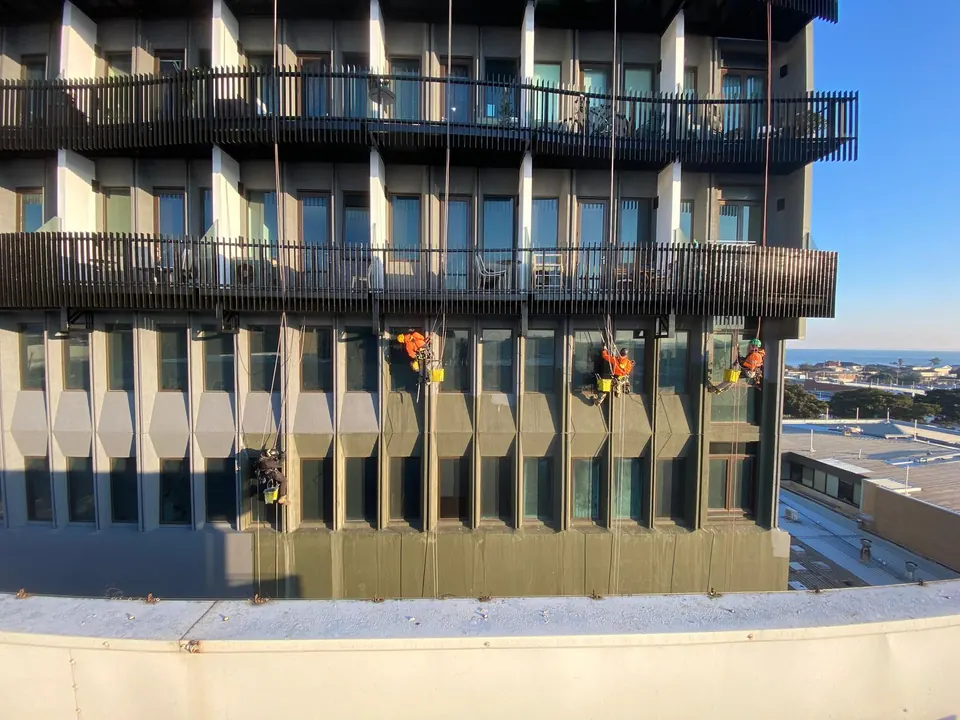
How rope access actually works on site.
Industrial rope access follows internationally recognised standards. Australian work-method statements align rope access to AS/NZS 4488 (the local industrial rope-access standard). The system's defining features:
- Two independent ropes. Every technician is suspended from a working rope and protected by a separate back-up rope. Each rope rigs from an independent anchor. Either one fails, the other catches you. There is no single point of failure in the system.
- Trained technician levels. L1 (entry — supervised access and tasks), L2 (rigging and rescue capability), L3 (site supervisor — sets the scope, signs off the rescue plan, supervises L1s and L2s). Every site must have an L3 supervisor present whenever rope-access work is happening.
- Documented rescue plan on every site. Before any technician deploys, there is a written rescue plan covering each scenario: technician incapacitated mid-rope, anchor failure, weather-induced shutdown. The plan names the rescue technician on duty for that shift.
- Daily kit inspection. Every harness, lanyard, descender, ascender, rope and connector is inspected at the start of every shift and recorded. Failed gear comes off the line immediately.
- Anchor strength testing and certification. Anchors are either pre-engineered (existing certified anchor systems) or installed and tested specifically for the scope by a competent person.
What gets done before any technician leaves the office.
Rope-access mobilisation isn't just a crew turning up. Before the first technician deploys, a defined documentation pack is issued and reviewed:
- Site-specific SWMS (Safe Work Method Statement) covering the rope-access methodology for this scope, this building, this access point. Generic templates don't pass induction at Tier 1 builders — every SWMS is written to the actual scope.
- JSA (Job Safety Analysis) per task. Each discrete task within the scope (rope deployment, anchor install, scope of work itself, rescue, recovery) gets its own JSA listing hazards, controls and competency requirements.
- Site-specific Rescue Plan identifying every reasonably foreseeable rescue scenario, the rescue route, the rescue technician and the escalation path if the in-team rescue capability is exhausted.
- Anchor review and certification — engineering review of existing building anchors (where present) or scope for anchor install (where required).
- Insurance certificate of currency ($20M public-liability cover; certificates of currency available for any scope).
- Pre-start meeting attendance. Most Tier 1 builders run a pre-start meeting on day-one of mobilisation; our L3 supervisor attends and walks the scope.
For builders, OCs and asset managers, this documentation is what separates a specialist rope-access contractor from a general-trades operator with a rope-access ticket. See our builder service path for detail on how the documentation pack fits Tier 1-3 builder onboarding.
How a rope-access site comes together.
Once the paperwork is approved and the crew arrives, the site set-up follows a sequence that varies by building but covers a consistent set of elements:
- Anchor rigging. Existing certified anchors verified or new anchors installed for the scope. Two independent anchor points per technician — never both ropes on the same anchor.
- Ground-level exclusion zone. Pedestrian-safety shielding below the work area; cones, signage and (where required) traffic-management or pedestrian-management plans.
- Weather monitoring. Wind speed at height (not at ground), rain prediction, lightning risk. Pre-defined trigger points pause work — no judgement calls in the moment.
- Communication. Radio between rope crew, ground crew, L3 supervisor and (where required) building management or tenant rep.
- Tools and consumables. Lowered to the work face via dedicated tool-lift line, separate from access ropes. Nothing dropped from height.
- Standby rescue. Rescue technician on standby for the duration of the shift — not deployed on other work, available to respond.
Rope access FAQs
What is rope access?
A method of working at height using ropes and certified techniques to reach areas that would otherwise need scaffold, an EWP or a BMU. Technicians work on two independent ropes under the two-rope system, with a documented rescue plan on every site.
What work can you do on rope?
Façade and glazing, remedial and sealants, cladding, high-access painting and coatings, inspections and surveys, install works and standby rope rescue — anywhere conventional access is slow, costly or disruptive.
Is rope access safe?
Yes — rope access is tightly regulated with a strong safety record: two independent ropes, certified technicians, method statements and a site-specific rescue plan. We provide standby rescue on every scope.
What's the typical day rate for rope access in Melbourne?
Day rate depends on crew size, technician levels and scope complexity. Programme works (multi-day or multi-week) attract better pricing than day-rate, and emergency call-outs land higher due to the speed of mobilisation. We quote scope-by-scope — send us the scope and we'll come back with a firm price, usually same day.
How quickly can rope-access mobilise compared with scaffold?
Planned scopes — typically 5-10 working days from contract execution and induction. Emergency make-safes — 24-48 hours where capacity allows. Scaffold by comparison usually requires 2-4 weeks to permit, erect and inspect. For most façade and remedial scopes, the mobilisation delta alone is worth more than the access-cost delta.
Do you carry rescue capability or do we need a separate rescue contractor?
We carry standby rope rescue on every scope we deliver — built into the day rate. We also provide standby rescue as a stand-alone service for builders running their own access crews. You do not need a separate rescue contractor when 360 Access is on site.
Which areas do you cover?
Melbourne and greater Victoria from our Tullamarine base, plus Queensland (Brisbane and the Gold Coast). With DIDO/FIFO capability we also mobilise to regional and remote sites Australia-wide.
Got a job at height?
Tell us the building, the scope and the timing — we'll respond within one business day.
Request a quote →